What Is Search Intent and How Do You Identify It?

You reached page one for your target keyword, impressions climbed, the graph in the report points up. But visitors bounce back after a few seconds and the form stays empty. More often than not this is not a ranking problem; it is the page offering something other than what the person who typed that query expected. Search intent describes exactly that gap: the difference between the words a user types and what they are actually trying to reach. Below we cover the types of search intent, how to identify them from the results page, and how to fix a mismatch.
What Is Search Intent?
Search intent is the goal behind the query a user types into a search engine. It defines whether that person wants to learn about a topic, compare options, is ready to buy, or is simply trying to reach a specific page.
The critical distinction is this: a query and an intent are not the same thing. Of two people typing “coffee maker”, one may want to learn what types exist while the other is about to compare prices and place an order. The search engine’s job is to tell those two apart; your job is to decide deliberately which side your page speaks to.
What Are the Types of Search Intent?
Search intent falls into four main groups. The table below summarises each type together with its position in the marketing funnel, the keyword modifiers that typically signal it, an example query, and the page type that satisfies it.
| Search intent type | Position in the marketing funnel | Typical keyword modifiers | Example query | Content and page type that fits |
|---|---|---|---|---|
| Informational | TOFU — top of funnel | what is, how to, why, guide, list | “how to do an SEO audit” | Blog post, guide, glossary page, infographic |
| Commercial investigation | MOFU — middle of funnel | best, vs, comparison, alternative, review | “best ecommerce platform” | Comparison table, review, case study |
| Transactional | BOFU — bottom of funnel | price, buy, order, discount, demo | “shopify pricing plans” | Product and category page, pricing page, quote form |
| Navigational | All stages | brand name, login, sign in, support | “google analytics login” | Brand homepage, login page, contact and support page |
-
Informational Intent
The user wants to understand a topic, learn a term or find an answer to a question. These queries sit at the top of the funnel; no purchase consideration has formed yet, so they carry no commercial signal and the expectation is an explanatory, impartial source. The query that brought you to this page belongs to this group. A page that serves this intent opens with a definition, answers the follow-up questions in order, and prepares the reader for the next step. The most common mistake is meeting these queries with a service page and confronting the user with an offer they are not ready for.
-
Commercial Investigation Intent
The user intends to buy but has not decided yet; they are comparing options, price ranges and other people’s experiences. This stage sits in the middle of the funnel and is where the content closest to conversion is produced. Comparison tables, reviews, pros-and-cons lists and real usage examples do the work here. Queries such as “how to choose an SEO agency” or “best ecommerce platform” carry this intent. The critical point is to compare the options honestly: a page that only describes your own solution does not meet the reader’s expectation for these queries.
-
Transactional Intent
The decision is made and only the action remains: buying, requesting a quote, signing up. These queries sit at the bottom of the funnel, where search volume is low and conversion value is high. The user expects a clear price, a short form or a product page directly — not a long explanation. If no price, plan or call to action is visible on the first screen, they leave. Entering such a query with a blog post produces no conversions, even if you rank.
-
Navigational Intent
The user already knows where they want to go and uses the search engine like an address bar. These queries do not belong to a single funnel stage; they can come from someone who has just heard of you as well as from an existing customer. The query usually contains a brand name plus an addition such as “login”, “dashboard” or “support”. What you need to do is rank first for your own brand queries and land the user directly on the page they expect. An intermediary site or a competitor ranking above you here means losing traffic that was already yours.
How Do You Identify Search Intent from the SERP?
Search intent is identified by reading four signals on the results page: the page type of the organic results, the SERP features, the ad density, and the modifiers in the query. Together these four show directly how the search engine interprets that query.
-
Page Type of the Organic Results
Page type is the single strongest signal of intent. Count the first ten organic results by type: blog post, category page, product page, comparison content. If blog posts dominate, the search engine is reading that query as informational intent; if category and product pages dominate, transactional intent is stronger. An even split means the query carries two intents at once and should be targeted with separate pages.
-
SERP Features
SERP features give away the format side of intent. A featured snippet and the “People also ask” box point to an information search, shopping results and product images to buying, a map pack to local intent, and a video carousel to an expectation of step-by-step demonstration. These features tell you not only the intent but also the format your content should take.
-
Ad Density
Ad density indicates the commercial value of a query. When a large number of ads sit above the results, the advertisers spending on that query expect conversions — meaning the intent is close to action. Queries where no ads appear at all usually carry pure informational intent.
-
Modifiers in the Query
A modifier is the word added to the head term of a query that determines its intent. Queries targeting the same entity end up on entirely different pages because of that one addition: “what is a coffee maker” points to learning, “best coffee maker” to the decision stage, and “coffee maker prices” straight to the transaction. This is why a keyword list should be grouped by the modifier a query carries, not by its head term.
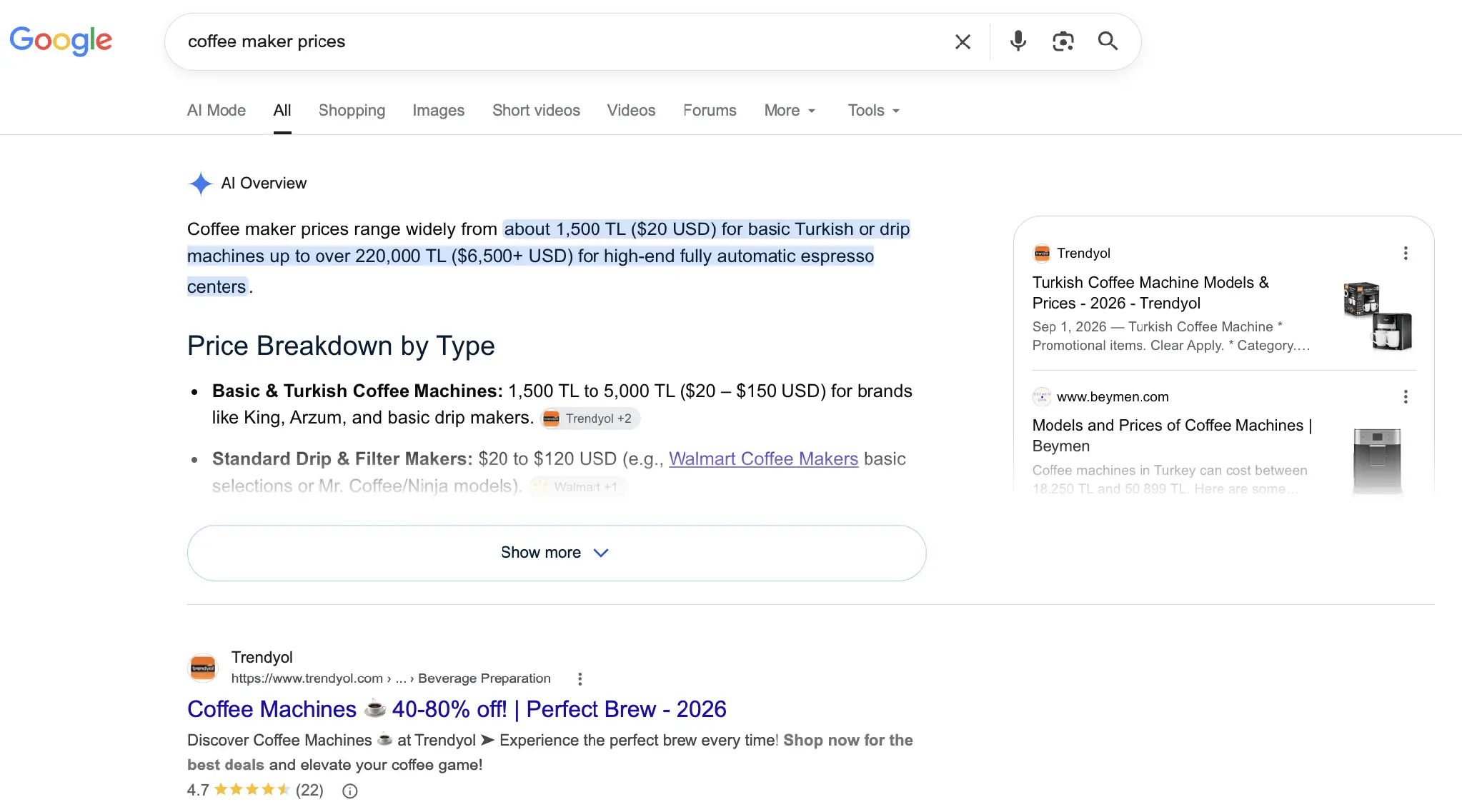
Figure 1: the query “coffee maker prices” — transactional intent. The answer opens with a price range in the AI Overview and everything below it is a retail listing. There is no natural place for a blog post on this results page.
Read together, the four signals show you how the queries around a single head term split into groups, and which page type each group should be met with. Search volume tells you the size of a query; the results page tells you what to do about it.
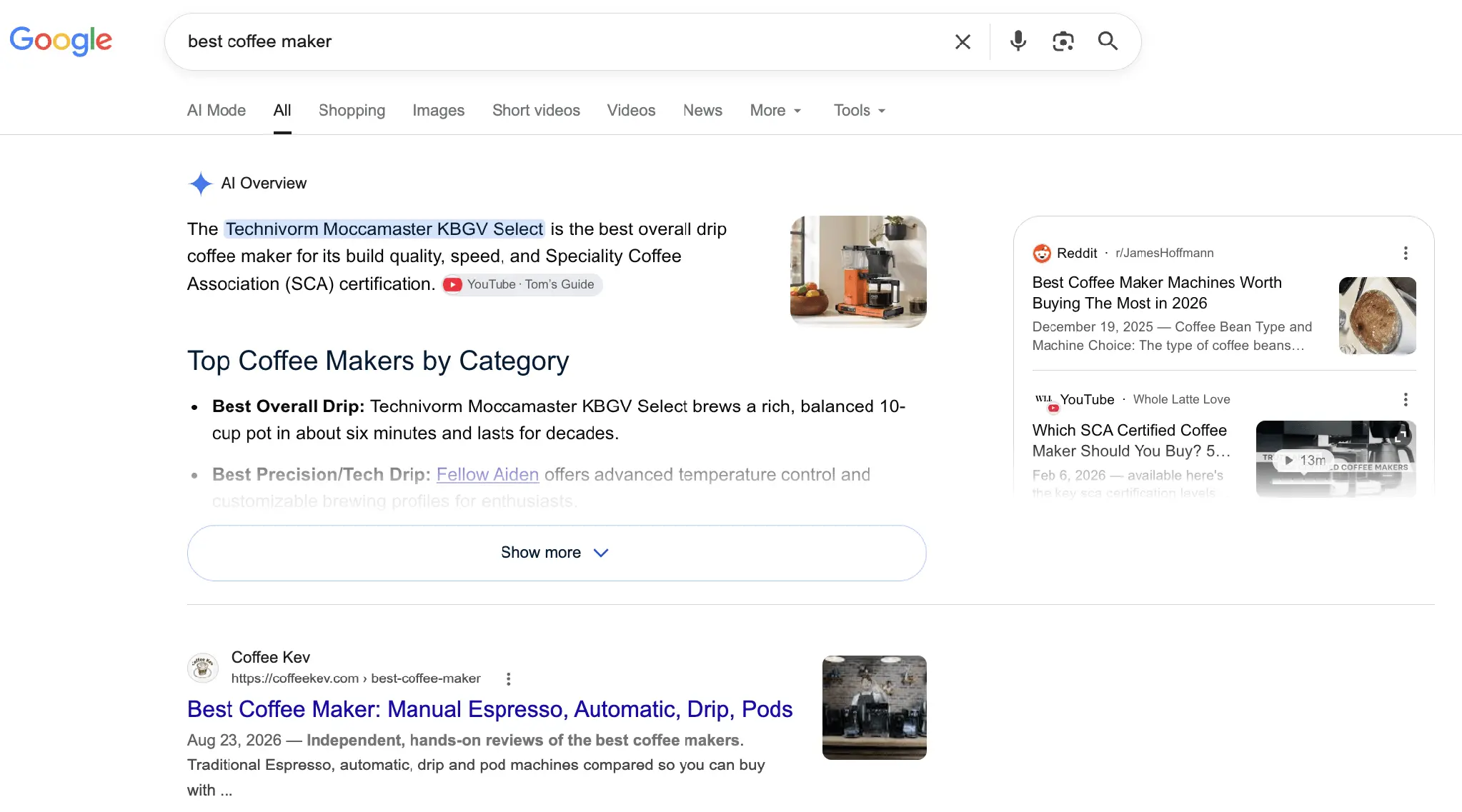
Figure 2: the query “best coffee maker” — commercial investigation intent. Only the modifier has changed, and the results page is rebuilt around it: the AI Overview names a specific model and the organic results are reviews and comparison content.
How Do You Spot and Fix Intent Mismatch?
Intent mismatch is a quiet problem; it never shows up in a report as an error. Two patterns stand out in Search Console data: queries with high impressions but a clearly low click-through rate, and pages that rank well yet produce no conversions at all. The first tells you the title does not meet the expectation set on the results page; the second tells you the page type was chosen wrongly.
There are three ways to fix it:
- Change the page type. If you rank with a blog post for a transactional keyword, move the target to a category or service page.
- Split the content. If a single page is trying to serve both a “what is” and a “price” query, two separate pages will serve both intents better.
- Hand the keyword over. If the page has the right content but ranks for the wrong keyword, redirect that keyword to the appropriate page through title edits and internal linking.
Leave an observation window of at least four weeks after each fix. Improvement in intent alignment usually becomes visible in click-through rate before it shows in rankings.
How Is AI Search Changing Search Intent?
As AI-generated answers spread across search results, the balance of intent shifts with them. A share of short, definitional informational queries is now answered on the results page itself; the user gets their answer without clicking. The practical consequence is that content which does no more than give a definition loses value, while commercial queries at the decision stage gain relative importance.
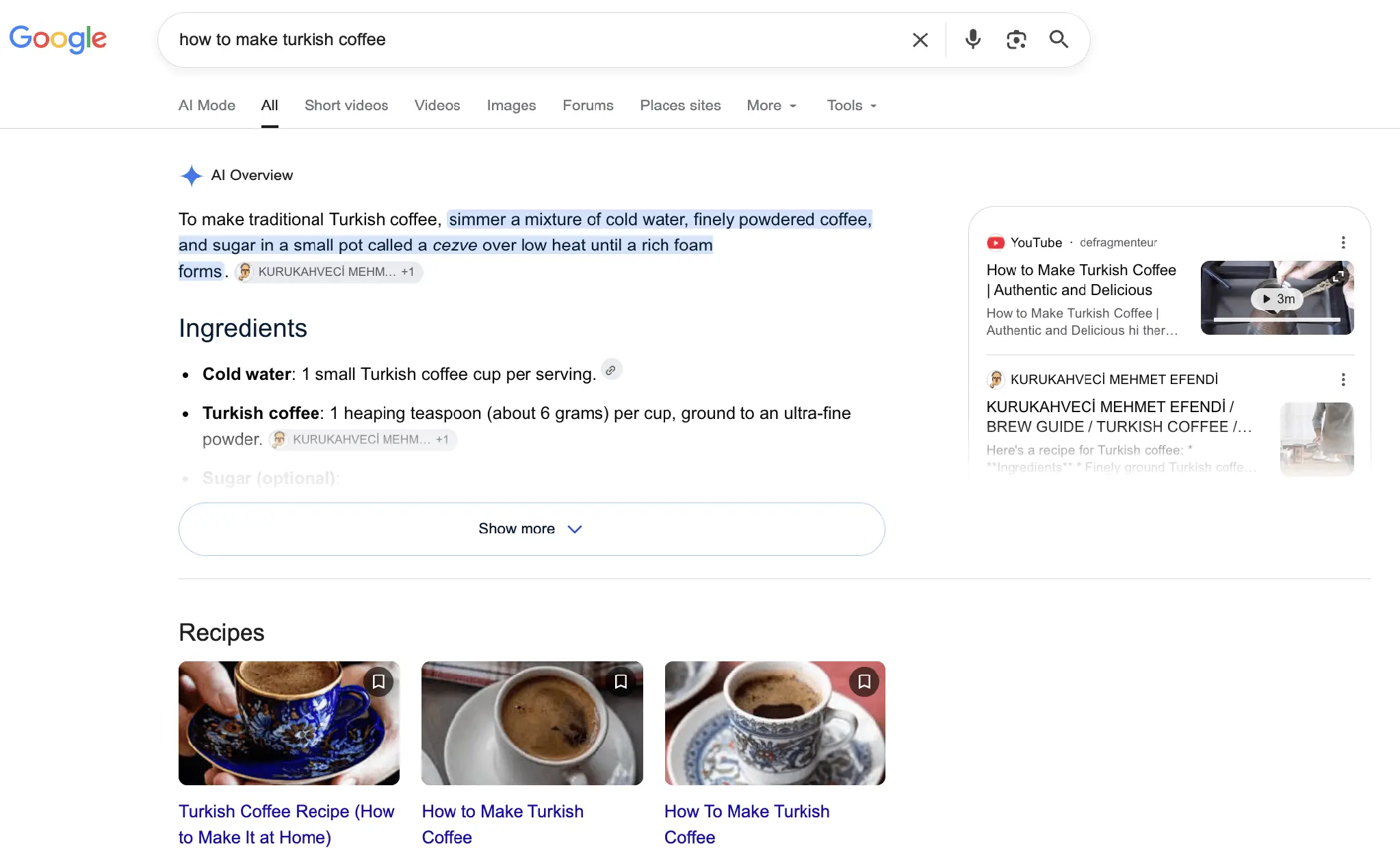
Figure 3: the query “how to make turkish coffee” — informational intent. The answer, ingredient list included, is delivered inside the AI Overview, with a recipe carousel and a video block below it. A page that only repeats the recipe finds it increasingly hard to earn a click here.
Rather than predicting this shift, you can partly measure it. Search Console’s generative AI performance report shows impressions of the links given to your site inside AI Overviews and AI Mode, broken down by page, country, device and date. Its limits matter: it carries impression data only — no clicks, no click-through rate, no position and no query breakdown. The report was rolled out to all sites worldwide on 31 August 2026. Clicks from AI features are not reported separately either; they are counted within your overall Web performance data. Even so, seeing which of your pages appear in these answers is enough of a starting point to move definition-level content towards content that supports a decision.
Why Intent Alignment Determines SEO Performance
Search intent is the link that separates rankings from results. At the same position, a page aligned with intent produces a higher click-through rate, longer engagement and higher conversion, because the visitor finds what they came for on the first screen. A misaligned page brings traffic but no revenue — and that difference is invisible in reports that track rankings alone.
This is why keyword selection should start with intent rather than volume. In Digimetri’s organic search work, the results page for every query is reviewed before the keyword list is finalised, and the target page type is decided accordingly. Reversing that order usually means months of content production spent on the wrong page type.
Frequently asked questions
To a limited extent. Informational and commercial investigation intent can be combined on the same page; the reader learns first, then compares. Trying to serve informational and transactional intent on a single page, however, usually weakens both.
Yes. Seasonal shifts, new product launches and changes in the news cycle can move a query’s intent. For the keywords that matter to you, the results page needs rechecking a few times a year.
Not always. The equivalent of a keyword can carry informational intent in one market and transactional intent in another. On multilingual sites, intent analysis must be done separately for each target market.
 LinkedIn

Keep reading
-
 Content & On-Page SEO
What Is E-E-A-T? Understanding Google’s Content Quality Framework
Content that is technically optimized for SEO, loads quickly, and targets the right search queries may still fall short of its expected visibility in search results. One key reason is that meeting technical criteria alone is not enough; the content must also demonstrate strong signals of experience, expertise, authoritativeness, and trustworthiness. E-E-A-T (Experience, Expertise, Authoritativeness, […]
-
Organic Search
Using Hreflang Tags on Multilingual Sites
A multilingual or multi-regional site holds more than one version of the same content. The search engine has to decide which of those versions to show to which user. The hreflang tag is the technical SEO implementation that defines this relationship. An incorrect or incomplete implementation produces two outcomes: users land on a page in […]
-
Organic Search
What Are Core Web Vitals? LCP, INP, and CLS Metrics
When some URLs are rated “poor” in the Core Web Vitals report in Google Search Console, that is a meaningful signal about the site’s overall performance. Those results, however, cannot always be explained by server infrastructure or page load speed alone. Assessing the various technical factors that shape user experience alongside Google’s measurement method is […]