What Is Social Media Advertising? Types, Platforms and How to Run Ads
Social media platforms have become one of the main touchpoints where consumers discover brands, compare products and shape their purchase decisions. Because platform algorithms limit the reach of organic content, however, regular publishing alone is rarely enough to meet brand awareness and sales targets. Social media advertising closes this gap by delivering a brand’s message to a defined target audience with a controllable budget, predictable reach and measurable results. This article covers what social media advertising is and how it works, AI-powered campaign models, ad types by platform, the steps to set up a campaign and how to measure performance.
What Is Social Media Advertising?
Social media advertising is paid promotional content that brands use to deliver their products, services or messages to a defined target audience on platforms such as Instagram, Facebook, TikTok, YouTube, LinkedIn and X. The end-to-end process of planning, publishing, measuring and optimising these ads is known as social media advertising management.
Two features set social media ads apart from traditional media: detailed targeting and near real-time measurement. With outdoor or print advertising, who the ad reached can only be estimated; with social media ads, impressions, clicks and conversions can be tracked throughout the campaign.
The Difference Between Social Media Advertising and Social Media Marketing
Social media marketing is the umbrella term for all of a brand’s activity on social platforms, including content production, community management, partnerships and advertising. Social media advertising is the paid media component of that whole.
| Organic posts | Social media ads | |
|---|---|---|
| Reach | Mainly existing followers, to the extent the algorithm allows | A defined target audience, independent of the follower base |
| Cost | No media budget required; involves content production and operating costs | Charged per impression, click or conversion |
| Duration of impact | Builds up cumulatively over time | Starts on launch and stops when the budget runs out |
The two approaches are complementary rather than alternatives: organic content builds trust in the brand, while advertising scales the messages that have proven to perform.
How Does Social Media Advertising Work?
Social media advertising runs on an auction model operated through each platform’s ads manager. When several advertisers want to reach the same user, the ranking depends not only on the bid amount but also on the quality of the ad and the likelihood that the user will engage with it. As a result, an ad that closely matches its target audience can win impressions even with a lower bid.
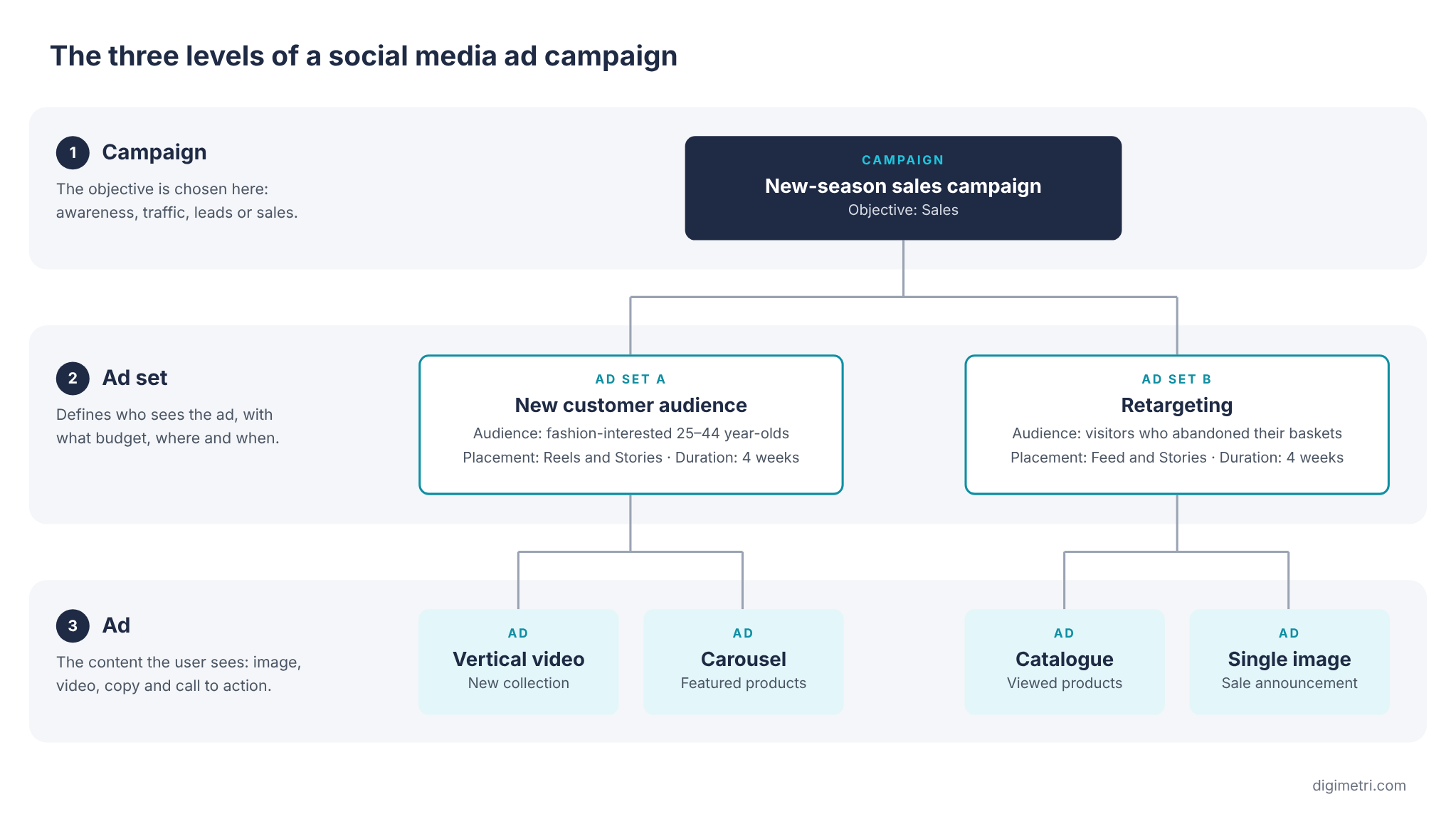
On most platforms, campaigns are built in a three-level structure:
- Campaign: The level where the marketing objective (awareness, traffic, leads or sales) is defined.
- Ad set: The level where the target audience, budget, placements and schedule are set.
- Ad: The level that holds the image, video, copy and call to action shown to the user.
Ad costs are tracked with metrics such as CPM, CPC and CPA. Each platform’s pricing and bidding options vary depending on the campaign objective, optimisation goal and bid strategy chosen.
AI-Powered Campaigns: Meta Advantage+ and TikTok Smart+
AI-powered campaigns are campaign set-ups in which most decisions about targeting, budget allocation, placements and creative matching are handed over to the platform’s machine learning systems. The advertiser defines the campaign objective, budget and creative assets; the system then continuously optimises which user sees the ad, in which placement and with which creative, based on conversion data. Two major platforms lead this approach today:
- Meta Advantage+: Hands audience, placement and campaign budget decisions over to AI in sales, app and leads campaigns. Advantage+ shopping campaigns, originally built for e-commerce, were renamed Advantage+ sales campaigns as their scope widened. Advantage+ creative features can also adapt image and text variations to each user.
- TikTok Smart+: The end-to-end automation solution TikTok previously offered as Smart Performance Campaign is now available as Smart+. Smart+ automates targeting, bidding and creative selection within a single campaign and supports sales, app promotion, lead generation and traffic objectives.
Although these campaigns reduce the manual set-up workload, they depend on two conditions to work efficiently: a measurement set-up that sends accurate conversion signals to the system, and enough creatives to test. Once targeting decisions are largely delegated to the algorithm, creative and messaging become the advertiser’s most effective lever over performance.
Social Media Ad Types and Platforms
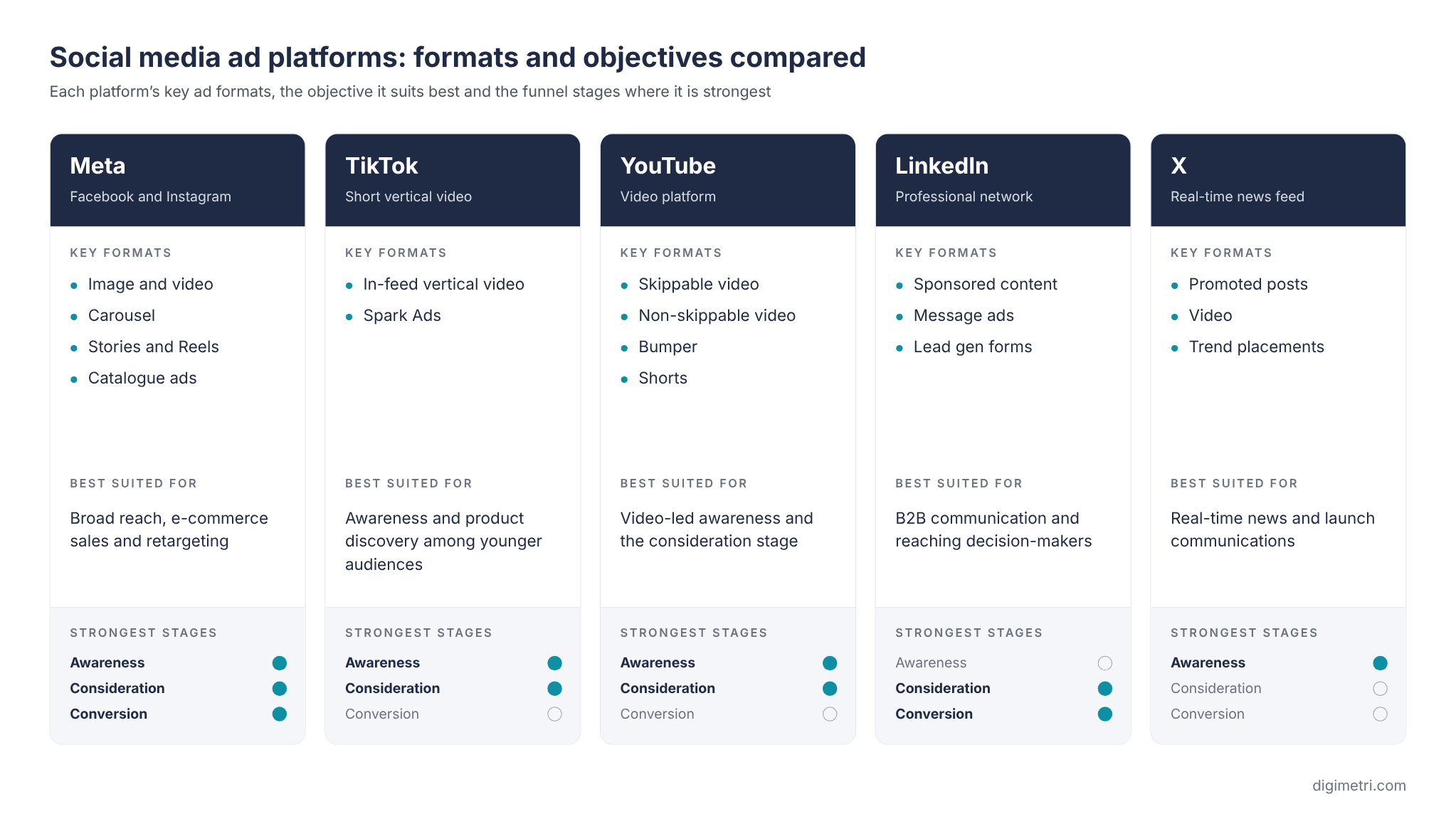
By format, social media ad types fall into image, video, carousel, Stories and vertical video, catalogue and lead form ads. Each platform offers these formats in ways that suit its own user behaviour:
| Platform | Key formats | Best suited for |
|---|---|---|
| Meta (Facebook and Instagram) | Image, video, carousel, Stories and Reels, catalogue ads | Broad reach, e-commerce sales, retargeting |
| TikTok | In-feed vertical video, Spark Ads | Awareness and product discovery among younger audiences |
| YouTube | Skippable and non-skippable video, bumper, Shorts | Video-led awareness and the consideration stage |
| Sponsored content, message ads, lead gen forms | B2B and reaching decision-makers | |
| X | Promoted posts, video, trend placements | Real-time news and launch communications |
For example, an online women’s fashion retailer can announce its new-season collection with vertical video on Instagram Reels and TikTok, then re-engage users who abandoned their baskets with catalogue ads. For a company selling payroll software to corporate clients, the same budget will work harder in LinkedIn lead gen form ads that target HR managers by job title and industry. When choosing a platform, the deciding factor is not popularity but where the target audience spends time during its decision process.
How to Run Social Media Ads: Setting Up a Campaign in 5 Steps
Whatever the platform, running social media ads involves five core steps:
- Define the objective and KPIs. Clarify whether the campaign serves awareness, traffic, leads or sales. The objective should be set as a measurable indicator, such as “keeping cost per acquisition below a set threshold”, rather than a general aim such as “increasing sales”.
- Identify the target audience. In addition to demographic, interest and behavioural targeting, build custom audiences from existing customer lists and website visitors.
- Choose the platform and format. Match the platform where the target audience is concentrated with a format that suits the campaign objective, and prepare creatives separately for each platform’s dynamics.
- Set the budget and bid strategy. Define a daily or lifetime budget; set a starting budget large enough to generate sufficient data, taking into account the campaign objective, audience size and expected cost per conversion. In the early period, avoid unnecessarily frequent changes so the algorithm has time to learn and meaningful data can build up.
- Set up measurement and launch. Configure the platform pixel, server-side conversion tracking and GA4 conversion events before the campaign starts, and add UTM parameters to links. Data collection should comply with applicable privacy laws such as the GDPR or Turkey’s KVKK.
In practice, measurement is the most frequently neglected step. In a campaign launched before tracking is fully set up, there is no way to tell which part of the budget is producing results.
Social Media Ad Management: How Do You Measure Performance?
Social media ad management is the ongoing process of monitoring, testing and optimisation that follows a campaign’s launch. Four core metrics are tracked throughout:
- CTR (click-through rate): Shows how much interest the ad generates among the target audience.
- CPC and CPM: Show the unit cost of traffic and reach.
- CPA (cost per acquisition): The unit cost of acquiring a customer or a lead.
- ROAS (return on ad spend): Shows the revenue generated for every unit of currency spent on advertising. ROAS does not equal profitability; it should be assessed alongside product margin and other operating costs.
These metrics should be read together rather than in isolation; an ad with a high click-through rate may not be contributing to sales.
Another critical topic is attribution modeling. Each platform reports its own contribution in its own dashboard; for a holistic view, this data needs to be compared with GA4 and CRM records.
Aligning Creative, Message and Landing Page
Targeting alone does not determine the performance of social media ads. A creative that captures the user’s attention in the first few seconds, a clear value proposition, a strong call to action (CTA) and a landing page consistent with the ad’s message need to work together. Because running the same creative for too long can lead to ad fatigue, different messages, formats and visual approaches should be tested regularly, and combinations of headlines, visuals and audiences compared through A/B tests.
Why Social Media Advertising Matters for Marketing Performance
Search ads and SEO are mostly strong at capturing existing demand. Social media ads, on the other hand, can create new demand by putting a brand in front of users before they actively search, and can also convert existing demand into sales through retargeting and conversion campaigns. Users who first meet a brand on social media often go on to search for the brand name directly in a search engine.
The limits of social media advertising should also be kept in mind: the impact fades quickly once the budget ends, costs rise as competition intensifies, and privacy regulations make measurement harder. Social media advertising is therefore not a growth strategy on its own but one component that works alongside organic search and other channels.
Frequently asked questions
There is no fixed price list for social media ads. Cost depends on the platform chosen, the level of competition in the sector, the size of the target audience, the time of year and the quality of the ad. During peak-demand periods such as Black Friday and November sales, reaching the same audience costs more.
Choose the platform where the target audience is active and that offers formats suited to the campaign objective. Starting with a single platform and expanding once results have been measured is a sounder approach than spreading the budget across several platforms from the outset.
Impression and click data starts coming in from day one. For the system to complete its learning phase and for conversion data to reach a meaningful volume, however, usually takes a few weeks; no firm conclusions should be drawn before then.
 LinkedIn

Keep reading
-
 Performance Marketing
What Is Retargeting? How It Works and How to Set It Up
In the run-up to Black Friday, a shopper lands on an online store, compares prices on a product page, adds an item to the basket and leaves before reaching checkout. They now know the brand and have shown clear interest in the product, but they have not made a decision yet. Retargeting is the advertising […]
-
Google Ads
Google Ads Campaign Types: Which Campaign to Use and When?
The first structural decision in a Google Ads account is not how much you spend — it is which campaign type you open. That single choice defines three things at once: the inventory your ads are eligible for, the stage of intent at which you reach the user, and how much room you leave for […]